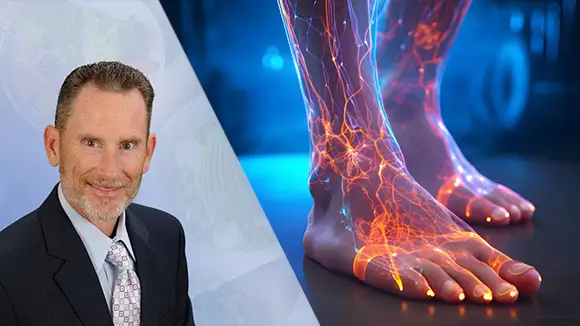
Men and women living with painful diabetic neuropathy are doing everything right —
controlling blood sugar, taking medications, following their doctor’s advice.
And still waking up at 2 or 3 AM with burning, stabbing pain that won’t stop.
The burning starts when the house goes quiet.
You already know what diabetic neuropathy is. You've lived with it.
The electric shocks...
The numbness...
The feeling of walking on gravel even when standing still.
Neurologists see this pattern all the time. Neuropathy pain often gets worse at night.
The biochemical mechanism behind this pattern is an active area of neurological research.
The Neurologist Who Took a Closer Look at How Nerve Biochemistry Is Being Studied
Dr. Lewis Clark has spent 27 years working specifically with patients who have painful diabetic neuropathy.
For most of that time, he believed what most neurologists still believe today.

"For most of my career, my clinical approach focused primarily on pain management and slowing progression."
"That remains the foundation of neuropathy care.
But emerging research prompted me to examine additional contributing factors."
"Particularly the biochemical environment surrounding the nerve fiber — not only the fiber loss itself."
"The research around MMP-13 enzyme activity in peripheral neuropathy added an additional dimension to how I examine cases.
The question I now also consider is what factors may be influencing the nerve's signaling environment."
"For patients in the early-to-mid stages of neuropathy, the nerve may not be permanently damaged yet. In many cases, it may simply be struggling to protect itself."
"Early awareness may help you make more informed decisions. That is what many patients wish they had understood sooner."
What researchers have found: Painful diabetic neuropathy does not always progress solely because blood sugar is out of control. In many cases, researchers are examining additional factors at the cellular level inside the nerve — contributing elements that current research continues to investigate beyond standard metabolic management.
The Nerve Mechanism Researchers Are Currently Studying
Inside every nerve fiber is a protective coating called the myelin sheath. Think of it like the insulation around an electrical wire. When that insulation is healthy, signals travel smoothly.
When that insulation may be affected, researchers believe it could influence how signals are transmitted.
This is one area researchers are actively studying in relation to neuropathy symptoms.
In people with diabetic neuropathy, researchers now believe that elevated glucose over time may trigger the overactivation of an enzyme called MMP-13.
The burning.
The stabbing.
The electric shocks.
The feeling that your feet are on fire when the house goes quiet at night.
Gabapentin is designed primarily to suppress pain signal transmission.
Research continues to examine what may be happening at the level of the nerve environment itself.
In many cases, researchers believe the nerve may still have some function remaining — but may be struggling inside an environment that makes it harder to maintain healthy signaling. That distinction is what much of the current research is focused on.
What People Living With Neuropathy Are Saying
These are accounts shared by people living with diabetic neuropathy who were looking for more clarity about their symptoms and options.
"I have had diabetic neuropathy for 6 years. Some days I can barely walk to the mailbox. The burning pain wakes me up every single night at 2 or 3 AM. I have been managing this for a long time and I am still looking for more information about what is actually happening with my nerves."
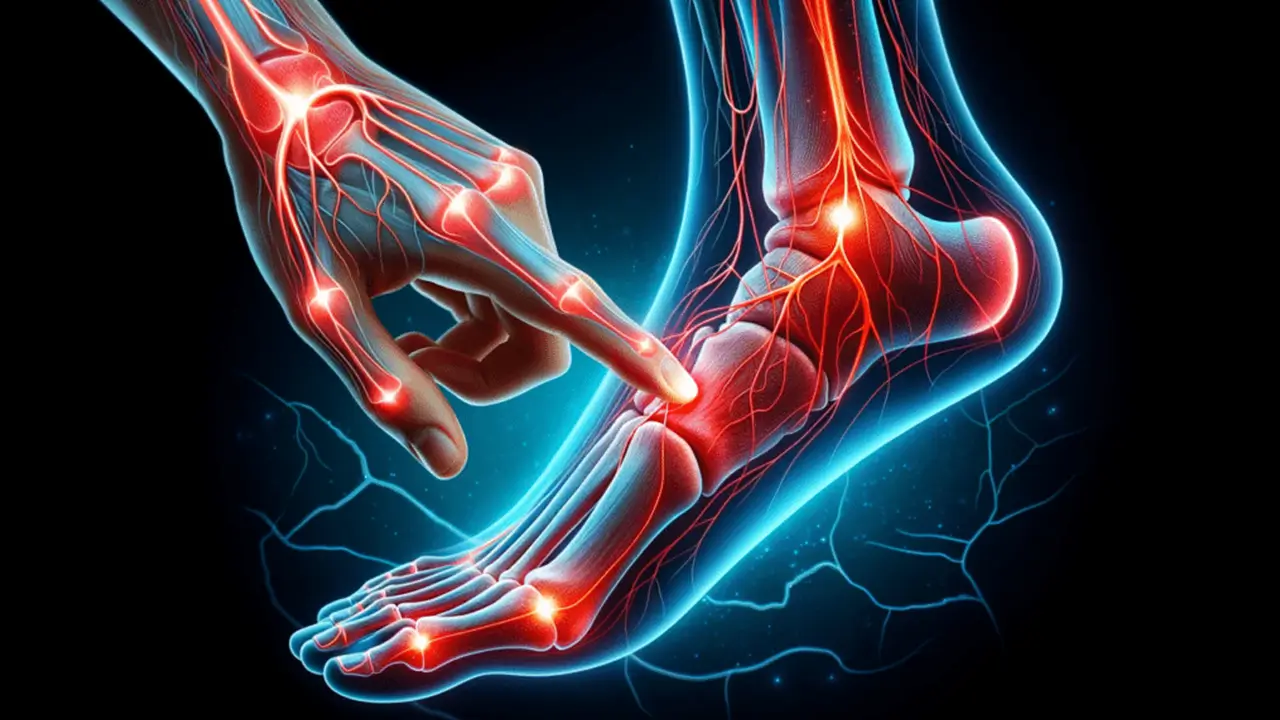
"Anyone else deal with the stabbing pain that shoots up from your feet at random times? I'll be sitting watching TV and BAM — feels like someone stuck a knife in my foot. Happens 10 to 15 times a day. Gabapentin helps a little but makes me so foggy I cannot think straight. I am 67 and feel like I am 90."
"I've been managing this condition for a while and I want to better understand what is happening at the nerve level. I'm interested in learning what current research suggests about the biochemical factors involved."